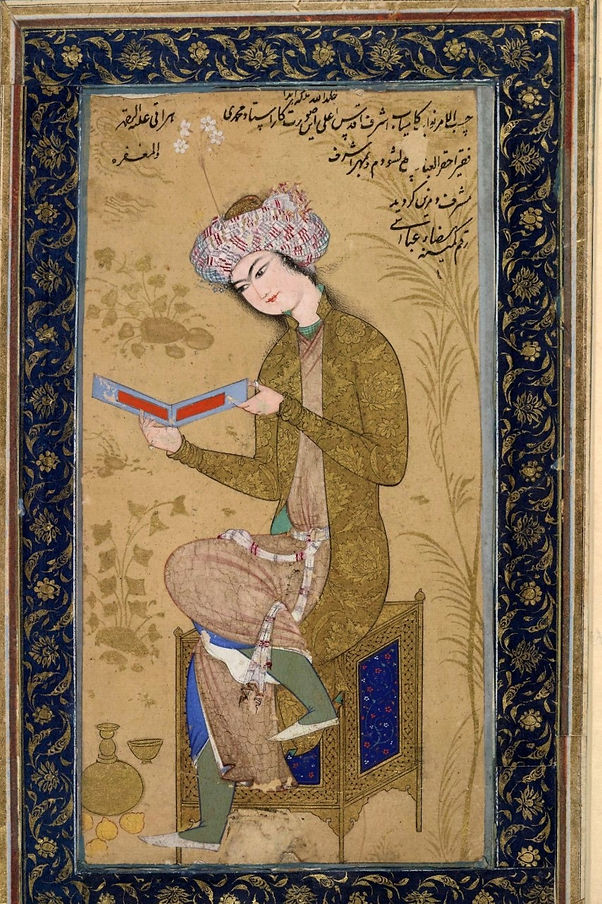
Cauldron of Stories
Lesson Objective: Students will learn about Reza Abbasi, the Safavid painter, his works, and his relations with the society he was taking apart during Shah Abbas the first
Homira Pashai 8-14-2020
Studies on Persianate Manuscripts, Arts, and Literature
Illustrations: Courtesy of the Metropolitan Museum of Art
Source: Azhand, Yaghoub(2006). Isfahan painting school, publications academy of art, Tehran.
Candy, Sheila R. (1996). Rebellious Reformer: the Drawings and Paintings of Rezayi – Abbasi of Isfahan, Tauris IB.
Reza Abbasi
Reza Abbasi رضا عباسی was Ali Asghar Kashi’s son علی اصغر کاشی , who was a prominent painter of Ibrahim Mirza’s ابراهیم میرزا workshop (brother of Shah Tahmasp شاه طهماسب) in Mashhad. Reza Abbasi was born in 1565 and learned painting under the supervision of his father and other renowned painters of the time. He worked in the workshops of Shah Ismail II شاه اسماعیل دوم in Qazvin and later Shah Abbas I in Isfahan. His single-page paintings created a style of art no longer dependent on the content of the manuscripts. He is also known as one of the first Persian painters to focus on society rather than the courtiers for his paintings.
In 1556, Shah Tahmasp signed “Edict of Sincere Repentance,” abstaining from worldly pleasures. Thus, many painters working at his court left for Mughal Indian court while others took the patronage of local courts and nobilities. As a result, the new style of more diverse single- page paintings commissioned by nobility started to appear in the form of Murraqa’s مرقع album pages. After Tahmasp, during the reign of Shah Isma’il II and Muhammad Khudabande محمد خدابنده, due to the social and political chaos of the time, art patronage was depressed. But the reign of Shah Abbas I brought stability and prosperity. Therefore, art and architecture flourished again.
At age 38 in 1603, Reza Abbasi received the epithet “Abbasi” from Shah Abbas the first. But soon, he was secluded from the courtly life and started painting wrestlers, dervishes, females, and the other classes of society. His paintings of this period are outstanding contributions to understating the social and anthropological elements of the Safavids. A decade later, due to the financial crisis, he found his way back to the court and worked in the imperial workshop again.
The incident that changed Reza’s attitude toward the court and caused him to find solace among commoners may have been the murder of his close friend and colleague, Mir Emad al-Hasani میرعماد الحسنی , the renowned calligrapher of the time of Shah Abbas I. Unfortunately, due to the rivalries that existed in the court, Mir Emad was abhorred by Shah Abbas, and finally, the shah ordered him to be murdered. Thus, Reza find the social traditions of the court in contrast with his beliefs. He separated himself from the court and focused on the street people, which brought a social change in Persian paintings. At this point, his art became more humanistic, mature, and unique in showing the peripheral people.
https://www.metmuseum.org/art/collection/search/451023
Terms:
Murraqa
Isfahan
epithet
Safavid
Find a painting of your interest, from the 16th century era, and share it with the class. Explain why you chose that subject.