Cauldron of Stories
Lesson Objective: Students will investigate the formation of a particular fashion, high- heels, and the cross-cultural history of wearing high-heel shoes by men.
Homira Pashai 2-22-2020
Studies on Persianate Manuscripts, Arts, and Literature
Pictures courtesy of Museum fur Islamische Kunst, Staatliche Museen zu Berlin, The J. Paul Getty Museum, Royal Collection Trust, Bata Shoe Museum, and The Hermitage Museum.
High-Heel Shoes of Persian Cavalry
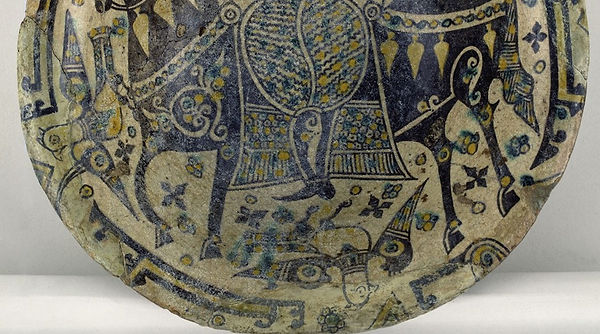
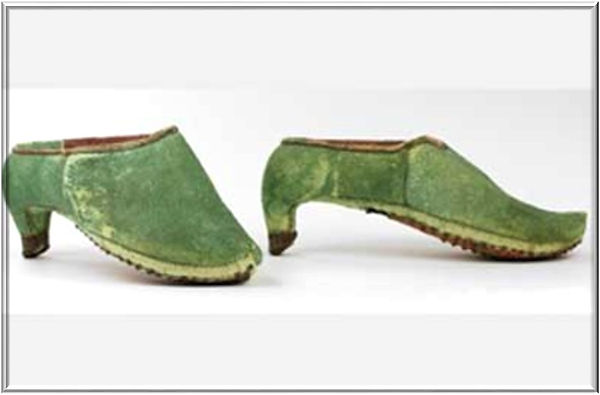
High-heel shoes were first used by Persian cavalry during the tenth century due to the fact that the heels helped the soldiers to keep their boots in the stirrups. Among the evidence that shows the use of high-heels by Persian cavalry, a dish from Nishapur, Iran, belonging to the Samanid era (847-1005 C.E.), highlights the history of wearing high-heel boots in Persia. Thus, Persian equestrian soldiers were the first to recognize that high-heel shoes would help them stay in their stirrups and have riding stability while using their bows and arrows.
By the end of the 17th century, the Persian cavalry of the Safavids still used one-inch heels as part of their attire. Little by little, high-heeled shoes became a symbol of social status, wealth, and refined fashionable taste. In 1599, Shah Abbas I of Safavids sent his first envoy to Europe, which resulted in a wave of interest in Persian culture among the Europeans. “Persia-Mania” became fashionable, and European nobilities adapted the Persian mode of dress. Thus, using Persian high-heels for men became a symbol of virility and prowess.
Under the influence of the Persian high-heel, Louis XIV passed the edict of 1670, indicating only the nobility had permission to wear heels. Red heels soon became his favorite, and only people who were allowed to wear red heels at his court were the ones who were in his good graces.
Persian high-heel also was added to the fashion of Early Modern English society in 1666 when King Charles II (1660-1685) reacted to the French influence on his court’s style by imposing the Persian model of the dress. High heels were worn by the knight of the Order of Garter until the mid-twentieth century.
Portrait of Fath-Ali Shah Qajar, 1772-1834 C.E.
Can you trace the history of Xerse opera by Francesco Cavalli in 1654 and connect the influence of it on the European fashion of the 17th century? (The Xerse was made into another opera by Giovanni Bonocini in 1694, and later in 1738 by George Frideric Handel as Serse)
Do you know how exactly something becomes fashionable?
Can you trace the history of a specific fashion during a particular era and write two-three paragraphs about it?
What elements would you have considered if you were to design a shoe, scarf, etc.? Please share with the class by the use of detailed drawings or the use of posters and pictures.
Terms:
Equestrian
Samanid era
Abbas I of Safavid
Louis XIV
Edict
King Charles II
Order of Garter