Cauldron of Stories
Lesson Objective: Students will examine the relation of art, music, and literature through three paintings from the Haft Awrang of Jami
Homira Pashai 2-15-2020
Studies on Persianate Manuscripts, Arts, and Literature
Illustrations: Courtesy of the Freer Gallery of Art, Smithsonian Institution, Washington, D.C.
Haft Awrang of Jami هفت اورنگ جامی
Haft Awrang is one of the classical Persian poetries based on seven masnavis, which Abd al-Rahman Jami completed in the 14th century C.E.
The masnavis include:
Chain of Gold
Joseph and Zulaykha
Rosary of the Pious
Salaman and Absal
Gift of the Free
Layli and Majnun
Alexander’s Book of Wisdom
سلسله الذهب
یوسف و زلیخا
سبحه الابرار
سلامان و ابسال
تحفه الحرار
لیلی و مجنون
خرد نامه اسکندری
These seven masnavis include three collections of didactic anecdotes, the story of Joseph and Potiphar’s wife, the Romance of Salaman and Absal, Layli and Majnun, and the story of Alexander the Great.
Making manuscripts in Safavid Persia was a collective project involving skilled papermakers, artists, scribes, illuminators, and binders. Manuscripts were usually commissioned by kings, queens, princes, and nobilities of various eras during the course of history.
The Ibrahim Mirza’s Haft Awrang is among the manuscripts made for a princely patron of the Safavid dynasty, Sultan Ibrahim Mirza, during 963-972/ 1556-1565. Ibrahim Mirza’s Haft Awrang is the product of the work of nine artists.
Ibrahim Mirza was the nephew of Shah Tahmasp, the Safavid, who married the daughter of Shah Tahmasp, Gowhar Sultan Beygom, and became the son-in-law of Shah Tahmasp. He was appointed as the governor of Khurasan for a while. Today he is known as a great patron and commissioner of the masterpiece manuscript of Haft Awrang, which is known as Ibrahim Mirza’s Haft Awrang since he commissioned it.
“Journey of the Prophet Muhammad, from the Masnavi of Alexander’s Book of Wisdom of Haft Awrang”
Muhammad rides Buraq across the blue sky, surrounded by angels. Archangel Gabriel and six other angels escort the prophet toward the celestial spheres. Can you describe the scene?
“Qays (Majnun) and Layli’s First Encounter”
In the romance of Layli and Majnun, Qays, who falls in love with Layli, turns into a wanderer madman since
he is not allowed to marry Layli. Layli and Majnun’s love ends up in the tragedy of their death.
Can you compare the story of Layli and Majnun with a western romance tragedy?
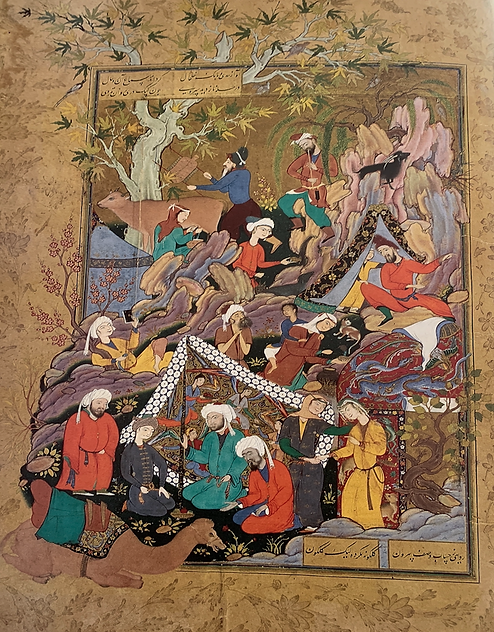
By locating the musicians in the picture, explain the festivities.
What does the number of figures in the picture tell you about the scene?
What do you know about the production of paper and manuscripts during the medieval era? Choose the role of a patron of art, artist, scribe, or illuminator, and in a journal entry, write two-three paragraphs about commissioning a manuscript or a painting or working on one as an artist.
Terms:
Masnavi
Didactic
Haft Awrang
Safavid Dynasty
Art Patronage
Shah Tahmasp
Ibrahim Mirza
Patron of art
illuminator
“The Aziz And His Bride, Zulaykha, Are Being Greeted by The Egyptians At the Gate of the City.” Another Romance masnavi of the Haft Awrang is Yusif and Zulaykha, the story of the prophet Joseph and Potiphar’s wife, which has been mentioned in Genesis 39 in the Bible.