Cauldron of Stories
Lesson Objective: Students will investigate the relation of art, literature, and culture by studying the symbolism of birds in general and Simurgh in particular with regard to Persian culture
Homira Pashai 4-28-2020
Studies on Persianate Manuscripts, Arts, and Literature
Illustrations: Courtesy of the Shahnama of Shah Tahmasp, Chester Beatty Library; New York Public Library.
Source: The Symbolism of Birds and Flights in the Writings of Ruzbihan Baqli by Carl W. Ernst
The Image of Simurgh سیمرغ in the Shahnama
The image of birds and flights has been used as a symbol of the ascension of the human soul in art and literature of various cultures. From the deities and angels of the ancient Near East to the winged souls of Plato’s Phaedrus and the Bible’s angels, the winged souls were depicted as the ones who had the power to lift the soul to paradise. As a result, the symbolism of flight has been used to highlight the ascension of the soul, and metaphors of birds flying expressed various modes of mystical experience. The soul, according to all the bird symbolism, “ascends like a heavenly bird to find its identity.”
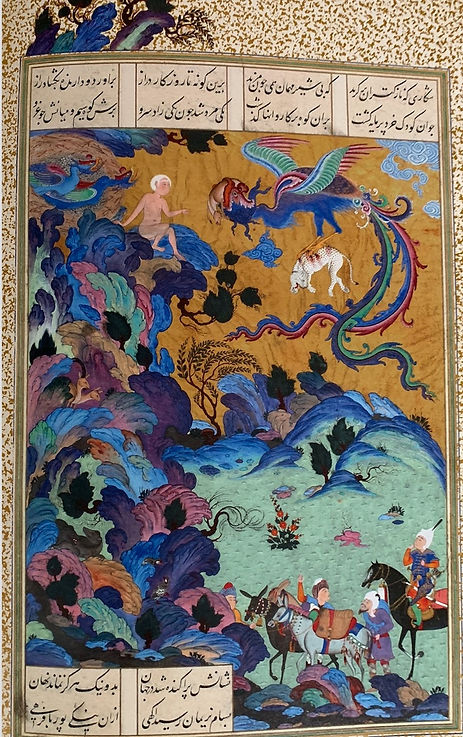
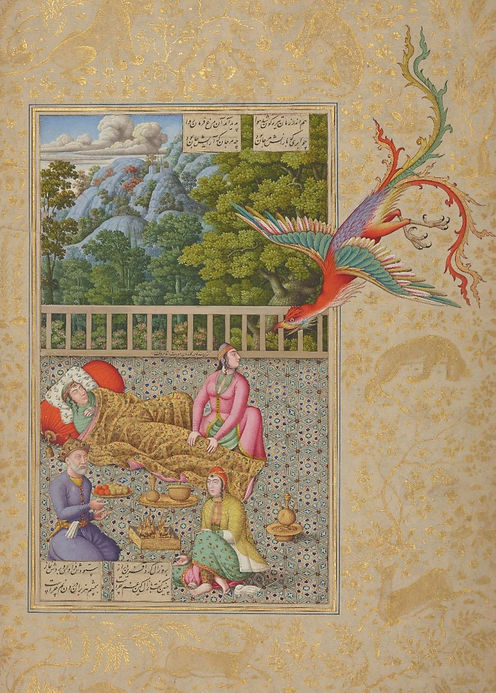
In the Shahnama, Simurgh is a supernatural bird and the helper of humanity. Simurgh is known to be the symbol of the divine help امداد غیبیto human in Iranian mythology and Persian literature. Simurgh appears first in the story of Zal زال. When King سام Sam’s son, Zal, is born, he has hair as white as snow. Sam, who perceives the baby as a demon, orders to take him to the Alborz mountain and leave him there. But the magical Simurgh finds Zal and carries him to her nest. Simurgh then takes care of Zal as one of her own. Years later, in his dream, Sam is reminded of his bad behavior toward his son. Thus, he decides to find Zal. As he finds Zal on the outskirt of the mountain, he decides to take him to his castle, but Zal hesitates and does not want to leave Simurgh. On the other hand, Simurgh sends Zal toward his father, Sam, while giving him a few of his feathers and telling Zal to burn one if he is in trouble. Simurgh promises Zal that she will come to Zal’s aid anytime Zal burns the feather.
Another appearance of the Simurgh is during the “birth of Rustamرستم .” As Zal marries Rudabeh, رودابه despite the obstacles that existed, Rudabeh expects her firstborn. She will give birth to the legendary Persian hero, Rustam, but giving birth to this lion cub proves arduous. Finally, Zal is convinced that he needs to call on Simurgh for help. Thus, he burns a feather, and Simurgh appears as divine help. Simurgh then arranges for a Cesarean Section, the first Cesarean birth noted in the literary history of Persia. Rudabeh’s health is preserved again with the herbs and roots that Simurgh prescribes for her to heal.
Simurgh’s last appearance in Zal’s life is during the “battle of Rustam and Isfandiyar اسفندیار.” As the years pass and Rustam is about to retire after all his ordeals, he is challenged by the young prince Isfandiyar. Rustam accepts the challenge and does not want to lose his legacy while leaving service. But as the battle advances, Rustam and his famous horse Rakhsh رخش are both gravely wounded. In the last days of battle, when hope forsakes Rustam in defeating Isfandiyar, Zal burns the last feather of Simurgh. Simurgh intervenes again as a divine help, this time telling Rustam that the fight with Isfandiyar is not a just cause. But hearing Rustam’s plea while healing Rakhsh, Simurgh informs Rustam that the only way to destroy Isfandiyar is by making a double-headed arrow from a tamarisk tree and aiming the arrow at Isfandiayar’s eyes since Isfandiyar is known to be “ro’intan” روئین تنinvulnerable.
Therefore, in the manifestation of Persian art and literature, Simurgh is a benevolent bird who appears as the divine help. The flight is a metaphor for the changes in the station of sanctity toward uplifting the human soul.
Can you name a few fantastic creatures or birds you are familiar with through the pop culture?
Please design and sketch a fantastic creature of your own and tell us in class what characteristics the creature you are presenting may have.
Terms:
Supernatural
Symbolism
Ascension
Plato
Phaedrus
Divine
Demon
Simurgh
Sam
Zal
Rudabeh
Rustam
Rakhsh
Isfandiyar