Cauldron of Stories
Lesson Objective: Students will examine the relation of art, mythology, and literature through two paintings from the Shahnama of Firdowsi (Ferdowsi)
Homira Pashai 4-15-2020
Studies on Persianate Manuscripts, Arts, and Literature
Illustration-source: The Shahnama of Shah Tahmasp
The Angel, Surush, in the Shahnama
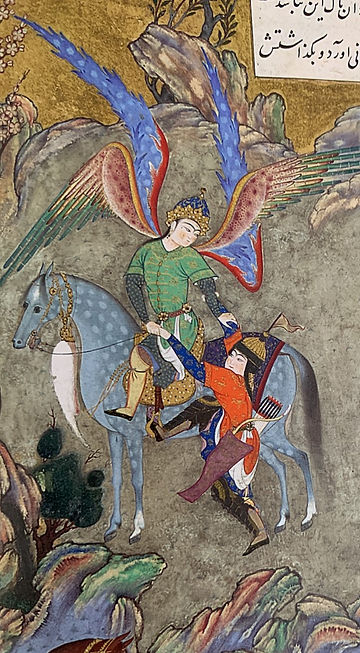
In the Shahnama شاه نامه (Book of Kings), Surush سروش is known to be the angel of conscience and the guardian of humankind. In Persian art, he is mainly depicted as a winged youth in a green garment riding a white horse. The angel, Surush, appears as the messenger of God, informing the warriors and kings about intrigues, conspiracy, injustice, and dangers. He also guidies humans against wrath, greed, and torment.
In the medieval reception of the Shahnama, Surush appears in various parts of the book guiding the protagonists. A great example is when Surush, on his horse, descends from heaven to save Khusraw Parviz خسرو پرویز, khusraw II خسرو دوم , from the usurper, Bahram Chubin بهرام چوبین. As Khusraw Parviz runs on top of a mountain while weeping and humbling himself before God, Surush emerges with his horse snatching Khusraw by his hand. While saving the King, Surush gives the supplicating King Khusraw the message of hope by enunciating King’s prosperous future.
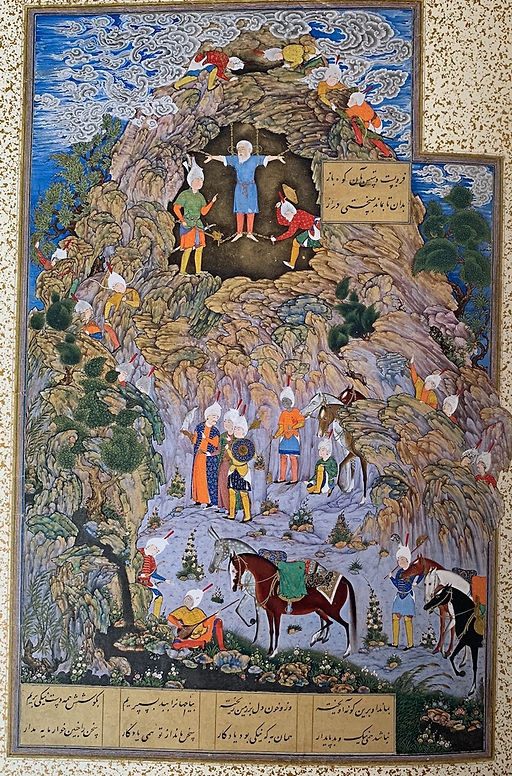
Likewise, in another part of the Shahnama, the saga of Fereydun (Faridun) فریدون , after the revolt of Fereydun and Kave کاوهagainst Zahhak ضحاک , the serpent king, Fereydun defeats Zahhak and arrests him. As Fereydun decides to kill Zahhak, Surush appears with a divine message. Surush then guides Fereydun to take Zahhak to the Damavand’s mountainکوه دماوند and binds him on top of the mountain to chastise him.
Thus, the angel, Surush, occasionally appears in the Shahnama as a messenger of the divine, teaching heroes or heroines how to survive life ordeal, make an honorable judgment, discover sublimated messages, and choose a redemptive path. In addition, he is known as the guardian angel after death and the warrior angel fighting the villains.
Describe the visual characteristics of Persian art that you can indicate in the folios above.
Describe the subject matter of each folio while comparing and contrasting them.
Terms:
Surush
Kave
Fereydun
Zahhak
Khusraw Parviz
Bahram Chubin
Damavand